Furcifer pardalis
Panther chameleon
1 active listing · Reptiles · Lizards
Category
Reptiles
Origin
Madagascar — northeastern Madagascar
Lifestyle
Terrestrial
Difficulty
Beginner
About the species
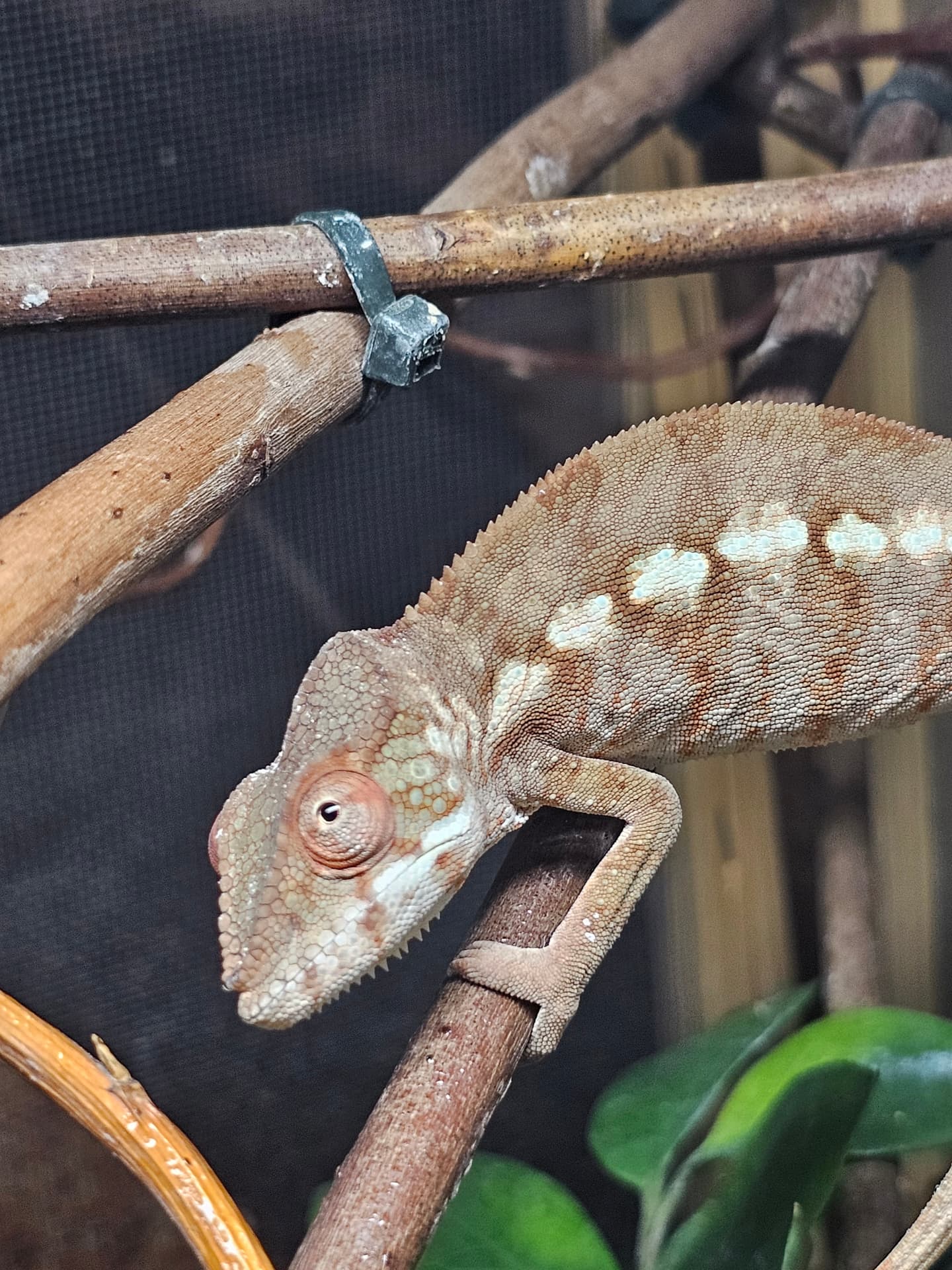
The panther chameleon (Furcifer pardalis) is an arboreal chameleon native to north-eastern Madagascar. The natural range is humid and seasonally humid forest and scrub along the island’s eastern and northern coasts, with local colour forms (localities). Introduced populations, including Réunion, are not native range and are not mapped as such. Males are clearly larger and more contrasting than females; an adult male often exceeds 40–50 cm total length. The species is territorial and is not kept in groups.
Origin and distribution
Madagascar — northeastern Madagascar
The species is endemic; its range is restricted to northeastern Madagascar within Madagascar.
Current listings
Care at a glance
Size
Males often 40–50+ cm; females clearly smaller
Enclosure type
Tall, screened or very well ventilated, with dense climbing structure
Temperature
Basking approx. 30–32°C; background approx. 24–28°C; a night drop
Humidity
High in morning and evening (mist); drier air between cycles
Furnishings
Branches of mixed diameter, plants, UVB, water as droplets rather than a deep bowl
Characteristics
Territorial and arboreal; sensitive to stale air and chronic stress
Care and behaviour
Furcifer pardalis needs vertical volume and moving air. Closed glass cubes without screen mesh overheat quickly. An adult male typically needs about 90×45×90 cm or larger, with mixed-diameter perches and plants for cover. UVB is required — the animal uses it while basking. It drinks mainly from droplets on leaves; morning and evening misting replace a drinking bowl the chameleon usually ignores.
Food is appropriately sized insects, rotated by species, with calcium and vitamins. Breeding females use more calcium. An all-cricket diet is poor practice. Temperature needs a gradient: a basking spot, a background zone, and cooler shaded perches. A uniform 32°C tank is a husbandry error.
Males defend territories and do not tolerate each other. A female is not décor beside a male — cohabitation outside controlled breeding causes stress and bites. Colour signals mood; darkening and gaping are warnings, not a show. Handling stays brief. Wash hands after contact.
Good to know
The genus Furcifer, including F. pardalis, is listed on CITES Appendix II. Legal origin and required papers matter at purchase. The species is non-venomous but fragile: stale air, missing UVB, and chronic stress shorten life faster than a single missed feed. Introductions outside Madagascar do not rewrite native range.