
Cyriocosmus elegans
3 active listings · Spiders
- Category
- Spiders
- Origin
- Venezuela, Trinidad and Tobago and Guyana
- Lifestyle
- Terrestrial
- Difficulty
- Intermediate
- Venom potency
- Weak
About the species
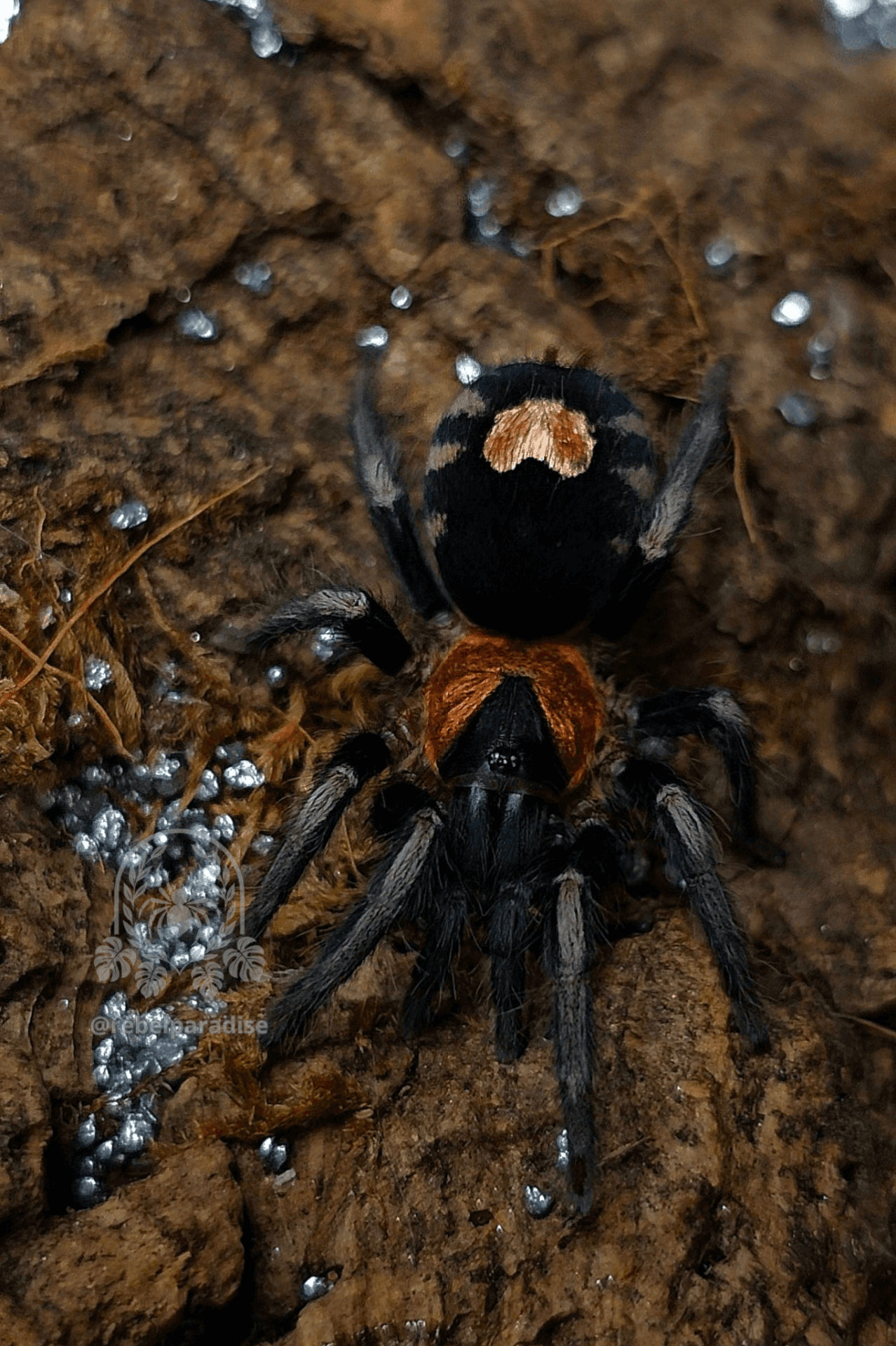
Cyriocosmus elegans is one of the smallest tarantulas in the hobby. Adult females reach a leg span of about 5–6 cm, and spiderlings leaving the egg sac measure only a few millimetres. The species comes from Venezuela, Trinidad and Tobago and Guyana. It has a dark body with orange and golden markings on the abdomen, which in Cyriocosmus often resemble a heart shape. It is a burrowing, silk-lining, skittish spider with urticating hairs. It suits keepers who like small setups, but raising the tiniest spiderlings needs attention.
Care at a glance
Size
Females about 5–6 cm leg span; about 2 cm body length
Enclosure type
Small, terrestrial, with deep substrate
Substrate
5–8 cm, lower layer kept slightly moist
Furnishings
Small piece of cork as burrow start, shallow water dish
Conditions
22–26°C, moderate humidity, ventilation
Characteristics
Dwarf, burrower, skittish, urticating hairs
Current listings

Origin and distribution
Venezuela, Trinidad and Tobago and Guyana
It occurs naturally in Venezuela, Trinidad and Tobago and Guyana.
Appearance and size
Body and legs are dark brown to black with paler rings at the joints. The abdomen has a pattern of orange, rusty and golden spots or bands, and in many individuals the central mark resembles the heart shape typical of Cyriocosmus.
Adult females reach a leg span of about 5–6 cm and a body length of about 2 cm. Males are even smaller and longer-legged. Spiderlings leaving the egg sac are only a few millimetres long.
Origin
Eugène Simon described the species in 1889 from a female from Venezuela. The World Spider Catalog gives the range as Venezuela, Trinidad and Tobago and Guyana; the Guyana record was added in 2023. On Trinidad and Tobago the species has been found, among other places, in burrows in roadside banks.
The genus Cyriocosmus contains many similar small species. When buying, choose spiders from a reliable breeding line, because juveniles of different species are hard to tell apart.
Enclosure and substrate
An adult female needs a container with a floor of about 15 × 15 cm or 20 × 15 cm. A deep layer of substrate (5–8 cm), in which the spider digs and silk-lines a burrow, matters more than floor space. A small piece of cork helps it start.
Keep spiderlings in very small containers with fine ventilation holes, as they easily squeeze through gaps. In a large enclosure a small spider struggles to find prey and the keeper struggles to monitor it.
Humidity and temperature
A temperature of 22–26°C is enough. Keep the lower substrate slightly moist at all times, because small tarantulas dehydrate quickly. Water part of the substrate along one edge rather than misting the burrow entrance.
A shallow water dish helps adults; for spiderlings a moist patch of substrate is enough. Ventilation is still needed, as an overly wet, stuffy environment encourages mould.
Feeding and growth
The smallest spiderlings need very small food: micro crickets, springtails, tiny roaches or pieces of larger insects. Adults do fine with small crickets or roaches once a week. Prey should be smaller than the spider’s abdomen.
Despite its small size, the species grows at a moderate pace. Males usually mature after about 1.5–2 years, females somewhat later. Females can live from several to over ten years.
Behaviour and handling
Cyriocosmus elegans is skittish and spends most of its time in its burrow. When disturbed it quickly hides, and less often rears up or kicks urticating hairs. Because of its small size and speed it is not suitable for handling.
Watch for escapes when opening the container. Use fine tongs for maintenance and rehouse over a large, light-coloured tub.
Good to know
Cyriocosmus elegans has urticating hairs that can irritate skin and eyes. The species is small and fast and escapes easily when the container is opened. It is not listed in the CITES appendices; obligations may depend on the country and the transaction, and this information is not legal advice.
Frequently asked questions
How big is Cyriocosmus elegans?
Adult females reach a leg span of about 5–6 cm, and spiderlings leaving the egg sac are only a few millimetres long.
Is Cyriocosmus elegans suitable for beginners?
Adults are easy to keep, but raising the smallest spiderlings needs tiny food and attention to moisture. It suits keepers with some experience.
What do Cyriocosmus elegans spiderlings eat?
Very small insects: micro crickets, springtails, tiny roaches or pieces of larger insects.
What enclosure does Cyriocosmus elegans need?
A small container, about 15 × 15 cm for an adult female, with 5–8 cm of slightly moist substrate and fine ventilation holes.
Where does Cyriocosmus elegans come from?
From Venezuela, Trinidad and Tobago and Guyana.
Similar species
Written by the Terra Market team ·