
Psalmopoeus reduncus – Costa Rican orange mouth
2 active listings · Spiders
- Category
- Spiders
- Origin
- Nicaragua and Costa Rica
- Lifestyle
- Arboreal
- Difficulty
- Intermediate
- Venom potency
- Medium
About the species
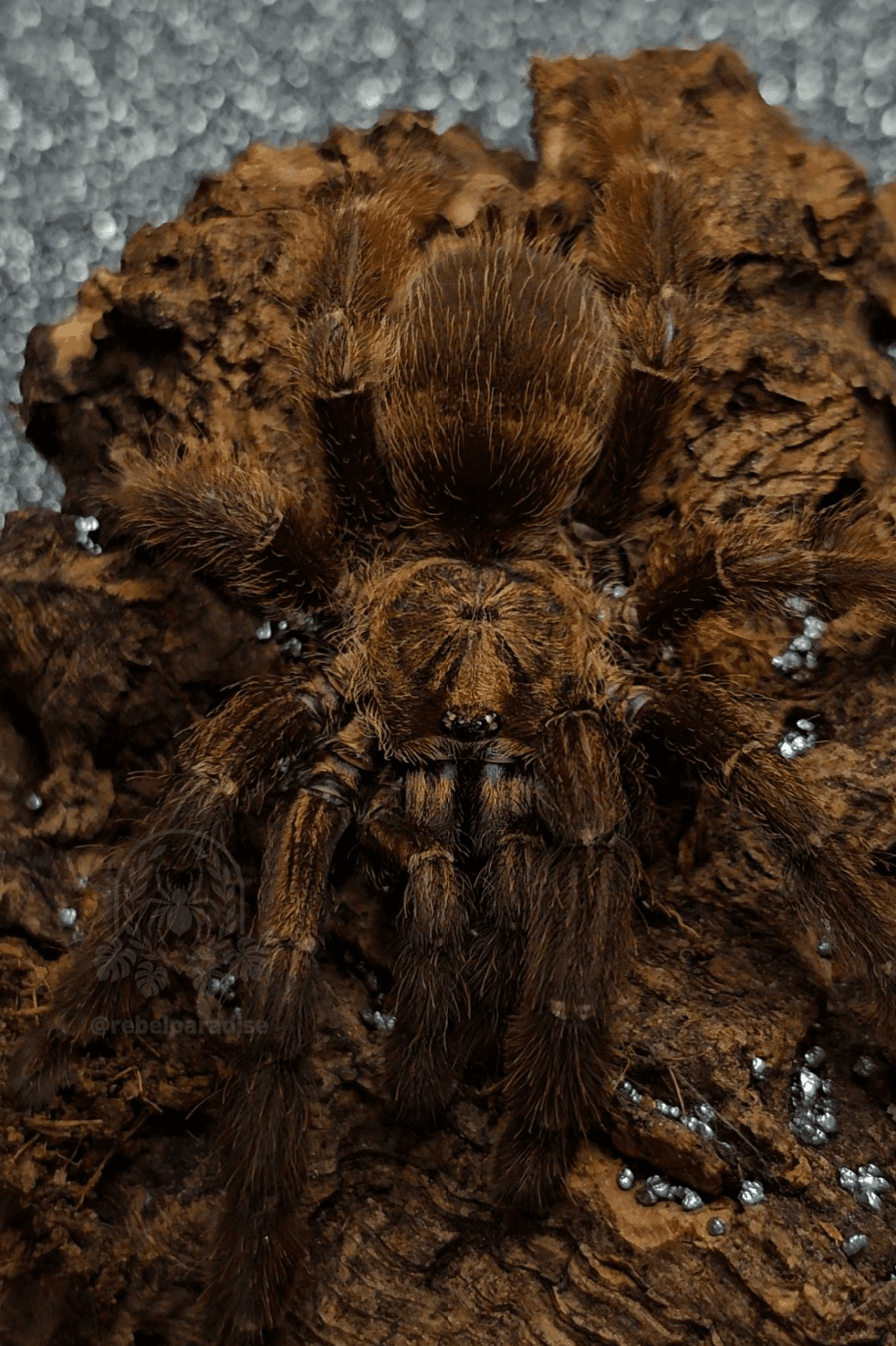
Psalmopoeus reduncus is an arboreal tarantula from Central America, described by Karsch in 1880. The World Spider Catalog gives a range covering Costa Rica and Nicaragua. In the hobby it is called the “Costa Rican orange mouth” after the orange setae around its chelicerae. It is olive-brown with a paler abdominal pattern and orange accents on the pedipalps. Like other Psalmopoeus it is fast, has no urticating hairs and defends itself by biting, so it is recommended for keepers experienced with arboreal species.
Care at a glance
Size
Females about 13–15 cm leg span
Enclosure type
Tall, arboreal, with cross ventilation
Substrate
5–8 cm, lower layer slightly moist
Furnishings
Vertical cork or tube, plants, water dish
Conditions
23–27°C, moderate humidity, airflow
Characteristics
Fast, no urticating hairs, potent venom
Current listings

Origin and distribution
Nicaragua and Costa Rica
It occurs naturally in Nicaragua and Costa Rica.
Appearance and size
Body and legs are brown to olive-brown, and the abdomen carries a paler pattern of transverse bands. Its most distinctive feature is the orange setae at the chelicerae and the tips of the pedipalps, which gave it the trade name “orange mouth”. The feet often show orange spots.
Adult females reach a leg span of about 13–15 cm. Males are slimmer and carry palpal bulbs after the final moult.
Origin and name
Karsch described the species in 1880. In their 2022 revision of Psalmopoeinae, Cifuentes and Bertani synonymised Psalmopoeus intermedius from Panama with it, but according to the World Spider Catalog a 2025 paper revalidated P. intermedius as a separate species. We therefore show a range covering Costa Rica and Nicaragua, without Panamanian records.
The species lives in humid forest, where it builds silk retreats in tree holes, under bark and in dense vegetation.
Enclosure
Height matters more than floor space. An enclosure of about 25 × 25 × 40 cm with vertical cork bark, a tube or dense plants works well for an adult female. The spider usually builds its retreat high up or behind the cork.
Front doors make maintenance easier without destroying the retreat. The enclosure must be escape-proof, because Psalmopoeus moves very fast.
Temperature, humidity and ventilation
23–27°C is enough. The lower substrate can be slightly moist, and an occasional misting of the cork helps. Keep a water dish available at all times.
The key is combining moderate humidity with airflow. Vents low at the front and high at the back prevent stale air and mould.
Feeding and growth
Juveniles eat small crickets or roaches every 4–6 days, adult females every 7–14 days. The spider catches prey near its retreat, so climbing insects or tong feeding work well.
The species grows fast. Males usually mature in about 1.5–2 years; females mature later and live more than 10 years.
Behaviour and safety
Psalmopoeus reduncus is fast and skittish and may rear up or bite if surprised. Bites from Psalmopoeus species are described as notably unpleasant: strong pain and sometimes muscle cramps.
Do maintenance with long tongs, with the room door closed and a catch cup ready. This species is not suitable for handling.
Good to know
Psalmopoeus reduncus has no urticating hairs, but it is fast, and bites from Psalmopoeus tarantulas can cause strong pain and systemic symptoms. Seek medical advice in case of a strong reaction; this page is not medical advice. The species is not listed in the CITES appendices; obligations may depend on the country and the transaction, and this information is not legal advice.
Frequently asked questions
Why is Psalmopoeus reduncus called the “orange mouth”?
Because of the orange setae around its chelicerae and at the tips of its pedipalps.
Is Psalmopoeus reduncus suitable for beginners?
Not really. It is fast, has no urticating hairs and defends itself by biting. It suits keepers experienced with arboreal species.
What enclosure does Psalmopoeus reduncus need?
A tall one, about 25 × 25 × 40 cm for an adult female, with vertical cork and cross ventilation.
How does P. reduncus differ from P. intermedius?
P. intermedius comes from Panama. It was synonymised with P. reduncus in 2022 but revalidated as a separate species in 2025. In the hobby, avoid mixing lines of different origin.
Where does Psalmopoeus reduncus come from?
From the humid forests of Costa Rica and Nicaragua.
Similar species
Written by the Terra Market team ·