
Bumba horrida – Brazilian redhead
3 active listings · Spiders
- Category
- Spiders
- Origin
- Brazil and Venezuela
- Lifestyle
- Terrestrial
- Difficulty
- Intermediate
- Venom potency
- Weak
About the species
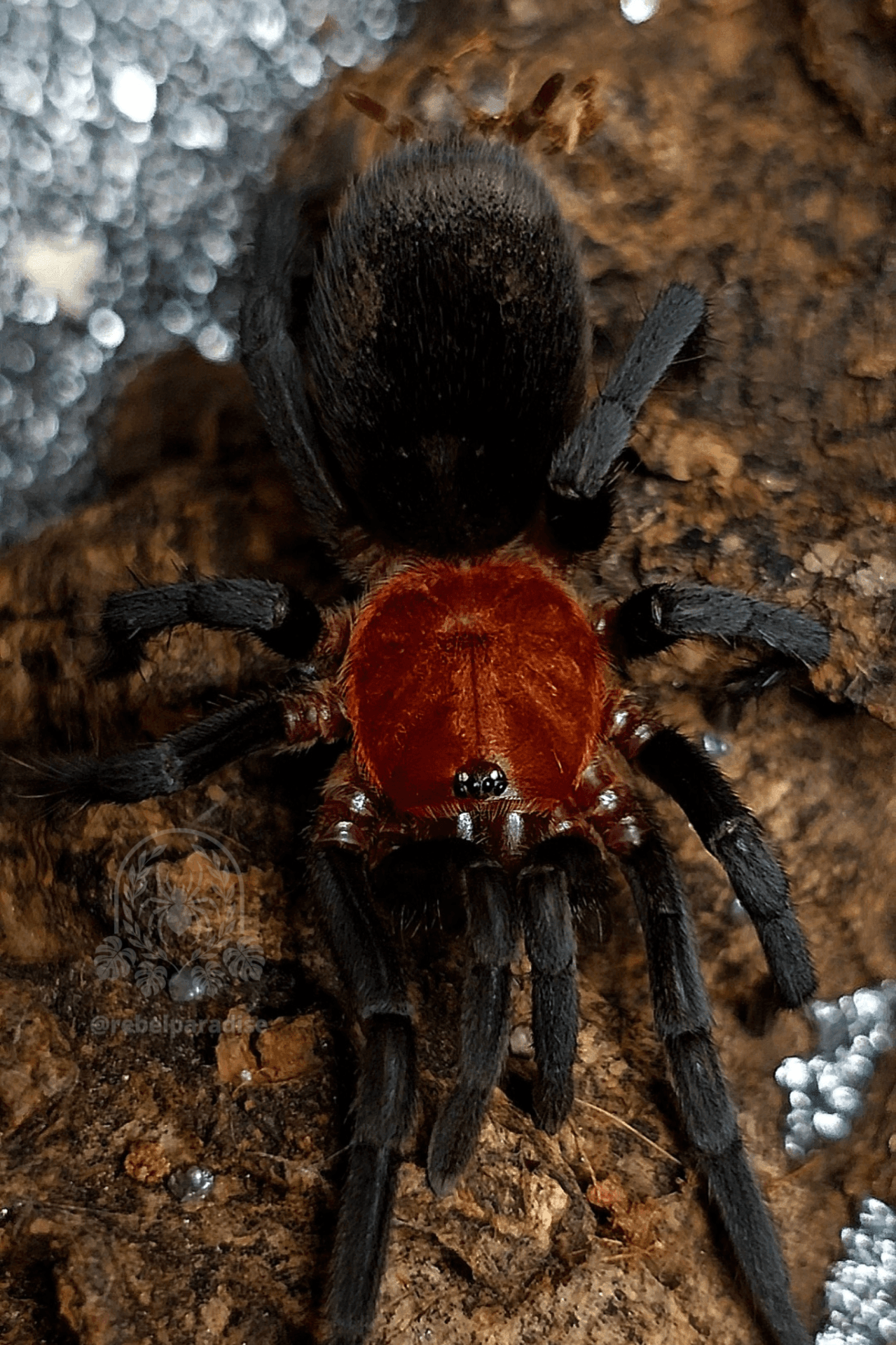
Bumba horrida is a medium-sized terrestrial tarantula from northern Brazil (Amazonas and Roraima) and Venezuela. In the hobby it is known as the “Brazilian redhead” after its rusty or coppery carapace, which contrasts with the dark body and legs. For years it was sold as Bumba cabocla, but in 2020 Lucas, Passanha and Brescovit synonymised that name with B. horrida. It is a shy spider that likes to dig shallow burrows and web their entrance, and it uses urticating hairs when threatened. It reaches a leg span of about 10–13 cm.
Care at a glance
Size
About 10–13 cm leg span in adult females
Enclosure type
Terrestrial, focus on floor space
Substrate
8–12 cm, lower layer slightly moist
Furnishings
Cork or half-tube as burrow start, water dish
Conditions
23–27°C, moderate humidity, ventilation
Characteristics
Shy, digs and webs, urticating hairs
Current listings


Origin and distribution
Brazil and Venezuela
It occurs naturally in Brazil and Venezuela.
Appearance and size
Its most distinctive feature is a rusty, coppery or reddish carapace that stands out against the dark brown to black legs and abdomen. Longer, paler setae cover the abdomen and legs. The colours are most intense shortly after a moult.
Adult females reach a leg span of about 10–13 cm. Males are slimmer, longer-legged and carry tibial hooks and palpal bulbs after the final moult.
Name and origin
Schmidt described the species in 1994 as Paraphysa horrida from a female from northern Brazil. It was later moved to Iracema and, because of homonymy, to Bumba. Lucas, Passanha and Brescovit (2020) synonymised Bumba cabocla, described from Maracá Island in Roraima, with B. horrida.
The range covers the Brazilian states of Amazonas and Roraima and Venezuela. Listings may still use the name “Bumba cabocla”; it is the same spider.
Enclosure and substrate
An adult female needs an enclosure with a floor of about 30 × 25 cm. The species digs shallow burrows under cork and webs the entrance area, so use 8–12 cm of substrate that is firm enough for a tunnel to hold. Keep the gap between substrate and lid small to reduce the risk of falls.
A piece of cork or a half-tube pressed into the substrate encourages digging in a chosen spot. Keep decor to a few stable pieces, as the spider rearranges its surroundings.
Temperature and humidity
23–27°C is enough. The species comes from Amazonian forest and the savannas of Roraima, so the lower substrate should be slightly moist while the surface may dry out. Keep a water dish available at all times.
Water the substrate along one edge every few days. Avoid permanently wet, compacted substrate without ventilation.
Feeding and growth
Juveniles eat small crickets or roaches every 4–6 days, adults every 7–14 days. The spider usually catches prey at the burrow entrance. Remove leftovers with tongs so they do not rot in the hide.
Growth is moderate. Males usually mature after about 2–3 years, females later.
Behaviour and handling
Bumba horrida is shy and often stays in or at the entrance of its burrow. Keepers’ reports on temperament vary: some individuals flee, others quickly rear up and kick urticating hairs. It is safest to assume the spider may defend itself vigorously.
The species is not suitable for handling. Do maintenance with long tongs, ideally while the spider is in its hide.
Good to know
Bumba horrida has urticating hairs that can irritate skin, eyes and airways, and they remain in used substrate. Avoid touching your face during maintenance. The species is not listed in the CITES appendices; obligations may depend on the country and the transaction, and this information is not legal advice.
Frequently asked questions
Are Bumba horrida and Bumba cabocla the same species?
Yes. In 2020 Bumba cabocla was synonymised with Bumba horrida. Both names are still used in listings.
Is Bumba horrida suitable for beginners?
Better for keepers with some experience. Care is simple, but the spider can be skittish and defensive and uses urticating hairs.
How big an enclosure does Bumba horrida need?
An adult female needs a floor of about 30 × 25 cm and 8–12 cm of firm substrate for digging.
Where does Bumba horrida come from?
From northern Brazil (Amazonas and Roraima) and Venezuela.
Why is it called the “Brazilian redhead”?
Because of its rusty, coppery carapace, which contrasts with the dark body and legs.
Similar species
Written by the Terra Market team ·