Grammostola pulchra
Brazilian Black
1 active listing · Spiders
Category
Spiders
Origin
Brazil — Southern Brazil
Lifestyle
Terrestrial
Difficulty
Beginner
Venom potency
Weak
About the species
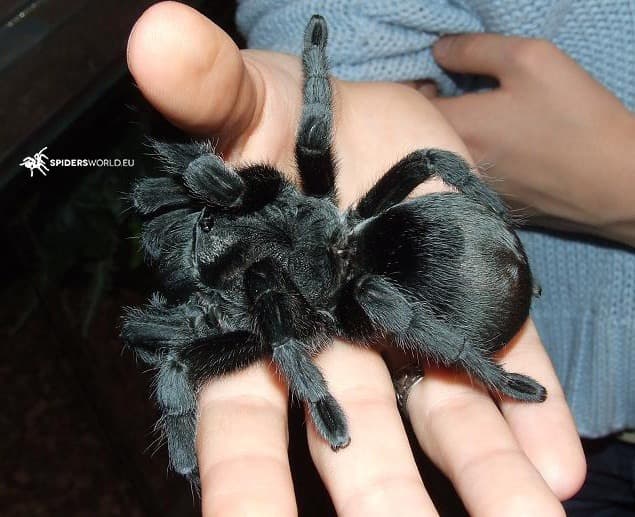
Brazilian Black (Grammostola pulchra) is a large terrestrial tarantula whose accepted World Spider Catalog distribution is Brazil. It should not be confused with Grammostola pulchripes, which has golden leg stripes and a wider South American range. Adults usually reach about 16–18 cm in leg span. The colouration is almost uniformly dark, often deep black, without bright knee rings. Like other New World Theraphosinae, the species has urticating hairs.
Origin and distribution
Brazil — Southern Brazil
The species is endemic; its range is restricted to Southern Brazil within Brazil.
Current listings
Care at a glance
Size
Leg span approx. 16–18 cm
Enclosure type
Horizontal, for a large terrestrial species
Substrate
A stable, thicker layer that allows shallow digging; the surface rather dry
Furnishings
A hide and constant access to fresh water
Conditions
Moderate to rather dry; good ventilation, without constantly wet substrate
Characteristics
Slower growth, dark colouration, urticating hairs, and calmer movement
Care and behaviour
Grammostola pulchra is a terrestrial species with a large body mass, so floor area and limited height matter more than a tall display tank. Substrate should be stable and thick enough for shallow digging or reshaping the hide entrance. A permanent water dish is needed even when the enclosure looks dry.
Most of the surface may remain rather dry, with a slight moisture gradient in the lower layers. Constantly wet substrate and poor ventilation do not suit this species. A single mandatory temperature or humidity percentage should not be imposed for all individuals and seasons.
Growth is slower than in many tropical species with a fast metabolism. Individuals often move more calmly and may remain in view for long periods, but this is not an animal for regular handling. Responses to disturbance vary between spiders.
Good to know
Grammostola pulchra has urticating hairs typical of many New World terrestrial tarantulas and may kick them off in defence. Contact can irritate the skin, eyes, and mucous membranes. The species is not listed on the CITES Appendices (unlike Grammostola rosea, which is listed at species level). National exotic-animal rules may still apply; this page is not legal advice. When working in the enclosure, limit contact with used substrate that may hold shed hairs.