
Hapalopus formosus – Pumpkin patch tarantula
3 active listings · Spiders
- Category
- Spiders
- Origin
- Colombia
- Lifestyle
- Terrestrial
- Difficulty
- Intermediate
- Venom potency
- Weak
About the species
Hapalopus formosus is a small terrestrial tarantula from Colombia and the type species of Hapalopus, described by Ausserer in 1875. In the hobby it is best known as the “pumpkin patch”, after the orange spots on its dark abdomen. Spiders sold as Hapalopus sp. Colombia in “small” and “large” forms are marketed under the same name, and their assignment to H. formosus is not always certain. The species grows fast, webs its hide heavily, is skittish and has urticating hairs. Thanks to its small size and simple care it is a popular choice as a second tarantula.
Care at a glance
Size
About 6–8 cm leg span (large form up to about 10 cm)
Enclosure type
Small, terrestrial, with deeper substrate
Substrate
6–10 cm, lower layer slightly moist
Furnishings
Cork or half-tube as burrow start, water dish
Conditions
22–27°C, moderate humidity, ventilation
Characteristics
Fast growth, skittish, webs, urticating hairs
Current listings


Origin and distribution
Colombia
The species is endemic to Colombia.
Appearance and size
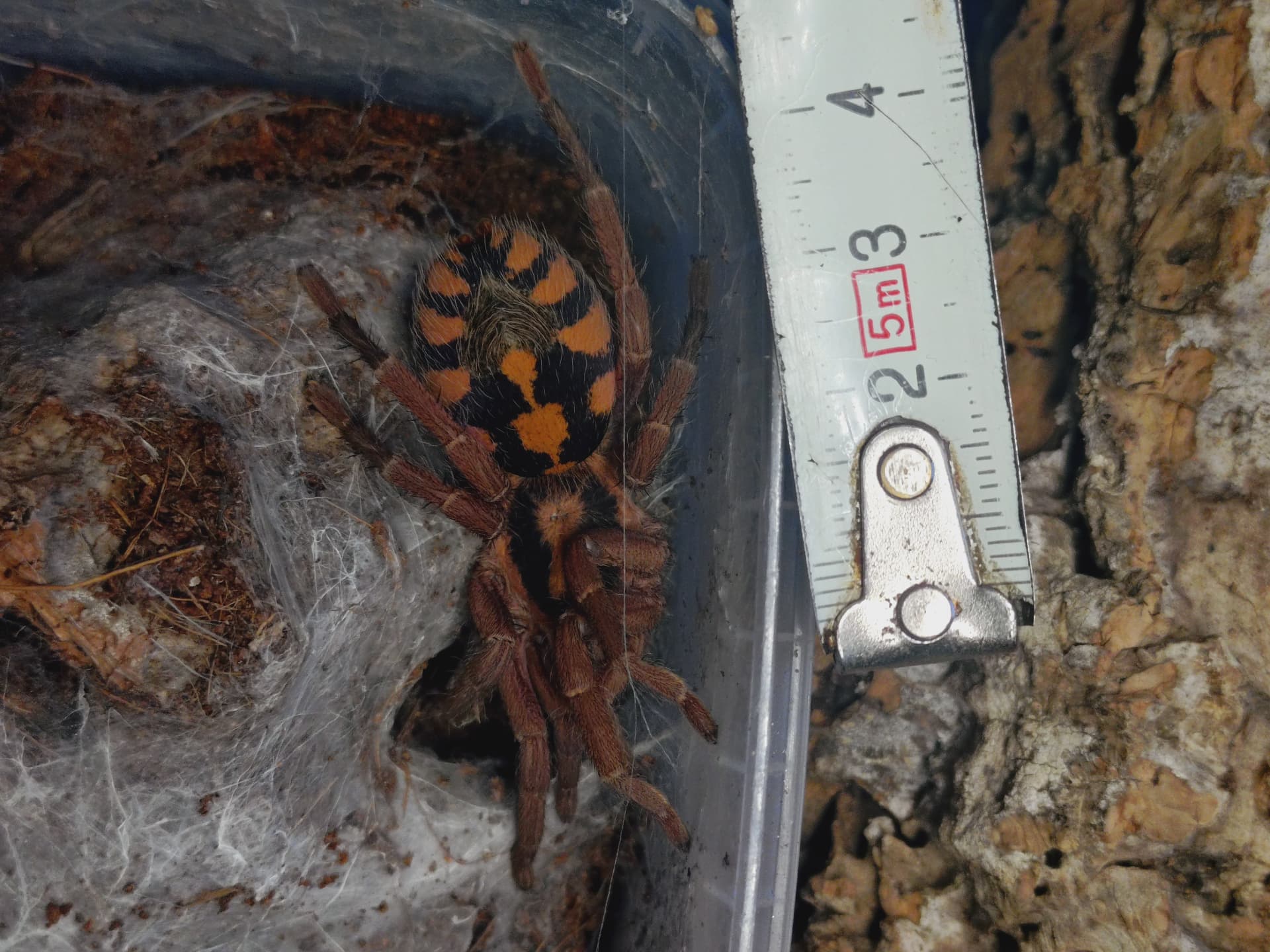
Hapalopus formosus has a dark, almost black body and legs and a distinctive abdomen with orange or golden spots in a clear pattern. The carapace often shows a golden sheen. The pattern appears early in juveniles, which makes them attractive from the first moults.
Spiders sold as the “small” form usually reach about 6–8 cm in leg span, the “large” form up to about 10 cm. Males are slimmer, have longer legs and clear palpal bulbs after the final moult.
Name and hobby forms
Ausserer described the genus Hapalopus in 1875 from a single adult male from Colombia. The World Spider Catalog lists the range as Colombia. In a 2024 revision, Sherwood and co-authors redefined the genus based on the holotype and considered an old Venezuelan record of this species to be a probable misidentification.
In the hobby the “pumpkin patch” circulates under several labels: Hapalopus formosus, Hapalopus sp. Colombia “small” and Hapalopus sp. Colombia “large”. Not every breeding line can be assigned to H. formosus with certainty. When buying, ask which form is offered and do not cross spiders from different lines.
Enclosure and substrate
An adult female needs an enclosure with a floor of about 20 × 20 cm or 25 × 20 cm. The species likes to dig shallow burrows and web their entrances, so use 6–10 cm of substrate. A piece of cork or a half-tube pressed into the substrate makes it easier to start digging.
Hapalopus formosus readily covers the area around its hide and the substrate surface with silk. Keep decor to a few anchor points and place the water dish where it is easy to refill.
Temperature and humidity
The species does well at room temperature, 22–27°C. The lower layer of substrate should stay slightly moist, while the surface may dry out. Watering part of the substrate along one edge every few days and keeping a water dish is enough.
As with most small tarantulas, stable conditions and airflow matter more than high humidity. Permanently wet substrate without ventilation leads to mould.
Feeding, growth and breeding
Juveniles take small crickets, roaches or cut mealworms every 3–5 days, adults once a week. It has a strong feeding response and usually grabs prey at the entrance of its hide. Remove leftovers with tongs.
Hapalopus formosus grows fast and can mature in about 1–1.5 years. Females produce egg sacs with many spiderlings, which is why the species is widely available. When breeding, pair spiders of the same hobby form.
Behaviour and handling
This is a fast, skittish spider that usually retreats to its hide when disturbed. It may kick urticating hairs or take a threat posture, especially when surprised outside its burrow. Bites are rare.
The species is not suitable for handling. Because of its speed, do maintenance with tongs, keep a catch cup ready and open the enclosure calmly.
Good to know
Hapalopus formosus has urticating hairs that can irritate skin, eyes and airways. Avoid touching your face during maintenance. The species is fast and can escape when the enclosure is opened. It is not listed in the CITES appendices; obligations may depend on the country and the transaction, and this information is not legal advice.
Frequently asked questions
Is Hapalopus formosus the “pumpkin patch”?
Yes, that is its hobby name. The same name is used for spiders sold as Hapalopus sp. Colombia “small” and “large”, and their assignment to H. formosus is not always certain.
What is the difference between the small and large forms?
The small form reaches about 6–8 cm in leg span, the large form up to about 10 cm. Their taxonomic status is not fully resolved, so they should not be crossed.
Is Hapalopus formosus suitable for beginners?
It works better as a second tarantula. Care is simple, but it is fast, skittish and kicks urticating hairs, so some prior experience with tong-based maintenance helps.
How big an enclosure does Hapalopus formosus need?
An adult female needs a floor of about 20 × 20 cm and 6–10 cm of substrate for a shallow burrow.
How fast does Hapalopus formosus grow?
Fast: with regular feeding it can reach adulthood in about 1–1.5 years.
Similar species
Written by the Terra Market team ·