
Nhandu coloratovillosus
2 active listings · Spiders
- Category
- Spiders
- Origin
- Brazil
- Lifestyle
- Terrestrial
- Difficulty
- Intermediate
- Venom potency
- Weak
About the species
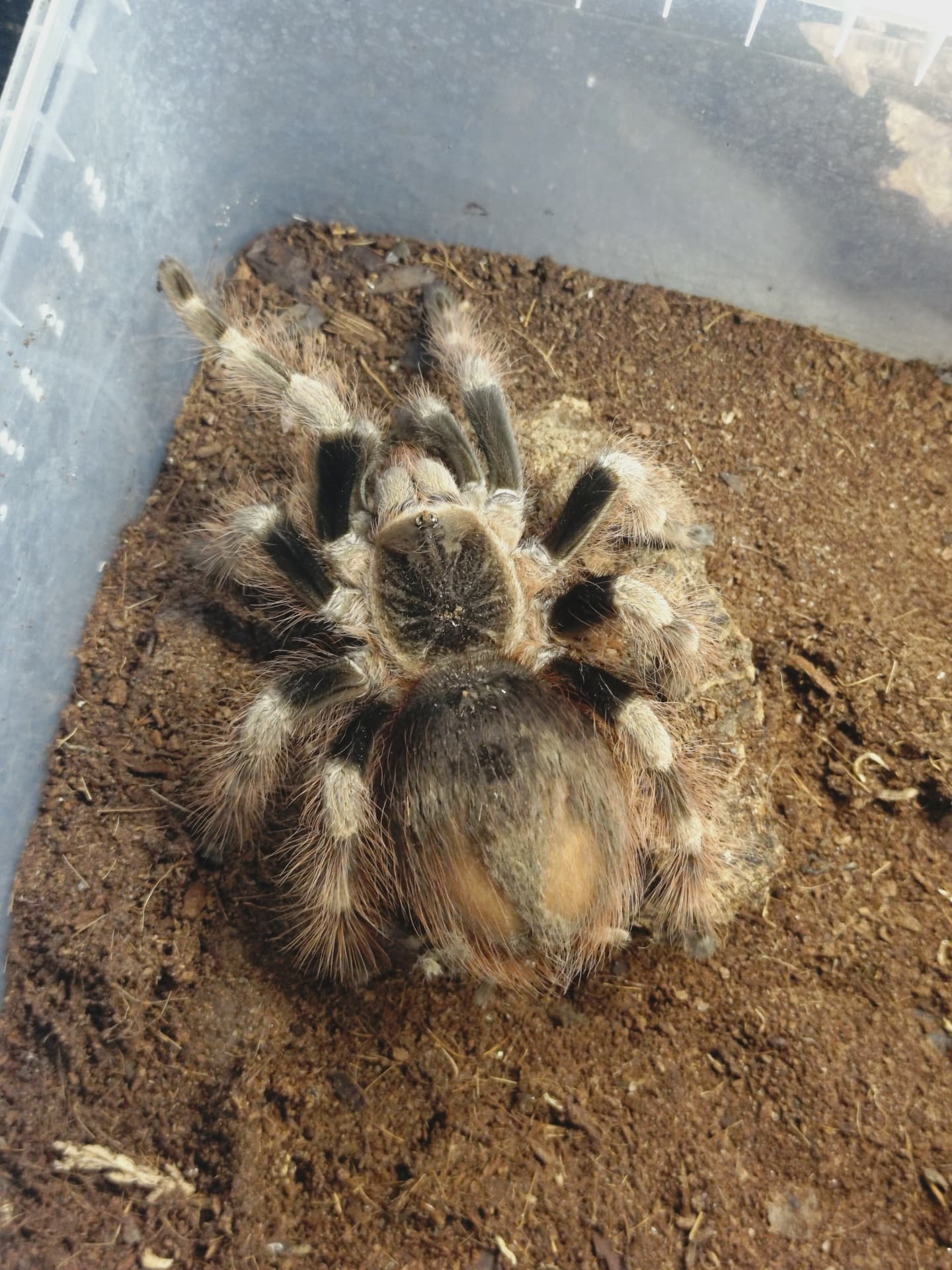
Nhandu coloratovillosus is a large terrestrial tarantula from Brazil, described by Schmidt in 1998 as Brazilopelma coloratovillosum and moved to Nhandu by Bertani in 2001. It has a black body, white stripes on the legs and long reddish hairs on the abdomen. The name “coloratovillosus” means “colourfully hairy”. In looks and care it resembles Nhandu chromatus and Nhandu tripepii. It grows fast, eats eagerly and is often on display, but it is nervous and uses urticating hairs.
Care at a glance
Size
Females about 13–15 cm leg span
Enclosure type
Terrestrial, horizontal; floor space matters more than height
Substrate
8–12 cm, lower layer slightly moist
Furnishings
Cork hide, water dish
Conditions
22–27°C, moderate humidity, ventilation
Characteristics
Fast growth, nervous, urticating hairs
Current listings

Origin and distribution
Brazil
The species is endemic to Brazil.
Appearance and size
Adults have a black or dark brown body, white stripes along the legs and white rings at the joints. Long red or orange hairs cover the abdomen and legs, giving the spider a “fluffy” look. Females reach a leg span of about 13–15 cm.
Juveniles are brown and less contrasting. The adult pattern develops gradually. Males are slimmer and carry tibial hooks after the final moult.
Origin and look-alike species
The World Spider Catalog gives the range as Brazil. Some sources also mention Paraguay, but in the catalogue Paraguay is attributed to another species of the genus, Nhandu carapoensis.
Nhandu coloratovillosus resembles N. chromatus and N. tripepii. Juveniles of these species are hard to tell apart, so a reliable origin and not crossing lines matter when buying.
Enclosure and substrate
An adult female needs an enclosure with a floor of about 40 × 30 cm. Use 8–12 cm of substrate so the spider can deepen its hide. Keep the gap between substrate and lid small, as a fall can be dangerous for a large tarantula.
A cork hide and a water dish are enough. The spider likes to dig and bury its dish, so limit decor to a few stable pieces.
Temperature and humidity
The species does well at room temperature, 22–27°C. The lower substrate can be slightly moist while the surface dries out. Watering part of the substrate along one edge every few days is enough.
Ventilation matters more than high humidity. Permanently wet substrate without airflow encourages mould.
Feeding and growth
Like other Nhandu it has a strong feeding response. Juveniles eat every 3–5 days, adult females every one to two weeks. Prey should not be larger than the spider’s abdomen.
Growth is fast. Males usually mature after about 2 years, females after 2–3 years. Females live well over ten years.
Behaviour and handling
Nhandu coloratovillosus often sits in the open but is nervous: it bolts, rears up or kicks urticating hairs. Bites are rare.
The species is not suitable for handling. Do maintenance with tongs and slow movements.
Good to know
Nhandu coloratovillosus has urticating hairs that can irritate skin, eyes and airways; they also remain in used substrate and on moults. Avoid touching your face during maintenance. The species is not listed in the CITES appendices; obligations may depend on the country and the transaction, and this information is not legal advice.
Frequently asked questions
Is Nhandu coloratovillosus suitable for beginners?
Better for keepers with some experience. Care is simple, but the spider is nervous and readily kicks urticating hairs.
How does it differ from Nhandu chromatus?
Both have a black body, white leg stripes and red hairs. The differences are subtle and juveniles are hard to tell apart, so buy from a reliable breeding line.
How big an enclosure does an adult female need?
A floor of about 40 × 30 cm and 8–12 cm of substrate.
Where does Nhandu coloratovillosus come from?
From Brazil. Paraguayan records in the catalogue belong to another species, Nhandu carapoensis.
How fast does it grow?
Fast: males usually mature after about 2 years, females after 2–3 years.
Similar species
Written by the Terra Market team ·