
Amazonius germani – Orange tree spider
3 active listings · Spiders
- Category
- Spiders
- Origin
- French Guiana and Brazil
- Lifestyle
- Arboreal
- Difficulty
- Intermediate
- Venom potency
- Weak
About the species
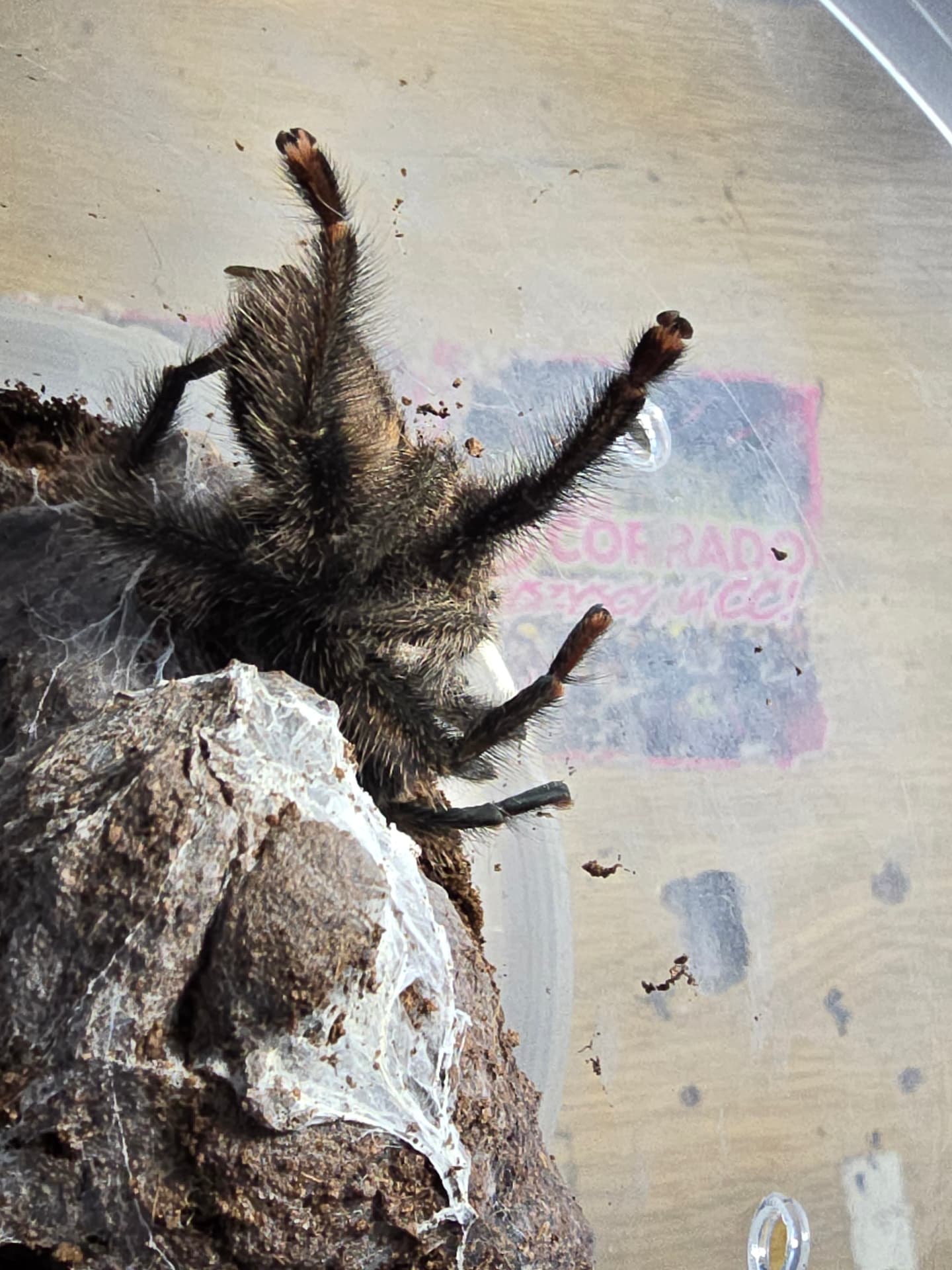
Amazonius germani is an arboreal tarantula of the subfamily Psalmopoeinae, known from French Guiana and the Brazilian Amazon. It was formally described only in 2022 by Cifuentes and Bertani, although it had long been in the hobby under the incorrect names Tapinauchenius gigas and Pseudoclamoris gigas. Adult females reach a leg span of about 12–15 cm and have a slim build with velvety, rust-brown to orange setae. It is a very fast spider that builds silk retreats in vertical crevices and has no urticating hairs. It suits keepers who already have experience with fast arboreal species.
Care at a glance
Size
Females about 12–15 cm leg span; males slightly smaller
Enclosure type
Tall, arboreal, with cross ventilation
Substrate
5–8 cm, lower layer slightly moist, never wet
Furnishings
Vertical cork bark or tube, plants, water dish
Conditions
23–27°C, moderate humidity with good airflow
Characteristics
Very fast, skittish, no urticating hairs
Current listings


Origin and distribution
French Guiana and Brazil
It occurs naturally in French Guiana and Brazil.
Appearance and size
Adult females of Amazonius germani usually reach a leg span of about 12–15 cm, with the slim body and long legs typical of arboreal Psalmopoeinae. The setae are short and velvety in rust-brown, copper and orange tones. The colour is clearly brighter after a moult and darkens before the next one, which explains the trade name “orange tree spider”.
Males are slimmer and carry palpal bulbs after their final moult. Juveniles are darker and less uniform in colour. Like other Psalmopoeinae, the species has no urticating hairs on the abdomen.
Name and origin
For many years this species was sold as Tapinauchenius gigas, and after 2018 as Pseudoclamoris gigas. In their 2022 revision of Psalmopoeinae, Cifuentes and Bertani showed these were misidentifications, described the new genus Amazonius and the new species Amazonius germani. The holotype is a female from Almeirim in Pará, Brazil; a male paratype comes from French Guiana.
The World Spider Catalog gives the range as French Guiana and Brazil. Brazilian material includes the states of Pará, Amazonas and Rondônia, in the lowland Amazon forest. Listings may still use the old names, so ask about the breeding origin when buying.
Enclosure
This is an arboreal species, so height matters more than floor space. An enclosure of about 25 × 25 × 35–40 cm works well for an adult female. The key element is vertical: a piece of cork bark leaning against or glued to the back wall, a cork tube or dense plants. The spider will build its retreat in the gap behind the cork or near the lid.
Front-opening doors make maintenance easier without disturbing a retreat that is often high up. A secure fit matters: Amazonius germani moves very fast and will use any gap around the lid. On the floor, 5–8 cm of substrate holds moisture and cushions any fall.
Humidity and ventilation
A temperature of 23–27°C and moderate humidity are enough. The lower layer of substrate can be slightly moist, and an occasional light misting of the cork or a wall gives the spider droplets to drink. A water dish is a good addition, although arboreal species often prefer drinking from surfaces.
The most common mistake with arboreal tarantulas is combining high humidity with no airflow. A steamy, stuffy enclosure encourages mould and moulting problems. Vents low at the front and high at the back (or in the lid) keep air moving.
Feeding and growth
Juveniles eat small crickets or roaches every 4–6 days, adult females every 7–14 days. Amazonius germani usually catches prey near its retreat, often high in the enclosure, so offer insects that climb readily or feed with tongs. Remove uneaten insects and leftovers from the retreat.
The species grows fairly fast. Males usually mature within 1.5–2 years, females later. Based on keepers’ experience, females can live more than 10 years, while mature males live much shorter.
Behaviour and safety
Amazonius germani is very fast and skittish. When the enclosure is opened it is more likely to run than to threaten, but it can bolt outside in a split second. Psalmopoeinae have no urticating hairs, so their defences are speed and biting. Bites from tarantulas in this group are often described as noticeably more unpleasant than typical bites from South American tarantulas.
Do maintenance calmly, with tongs, in a closed room and with a catch cup ready. Rehousing is best done inside a larger clear container or bag in which the enclosure is opened. This species is not suitable for handling.
Good to know
Amazonius germani has no urticating hairs, but it is very fast and can escape when the enclosure is opened. Take a bite seriously and seek medical advice in case of a strong reaction; this page is not medical advice. The species is not listed in the CITES appendices; obligations may depend on the country and the transaction, and this information is not legal advice.
Frequently asked questions
Is Amazonius germani the same as Tapinauchenius gigas?
In the hobby, yes: spiders sold as Tapinauchenius gigas or Pseudoclamoris gigas are mostly Amazonius germani. The 2022 revision showed the old identifications were wrong.
Is Amazonius germani suitable for beginners?
Not as a first tarantula. Care is simple, but its speed and skittishness call for experience with fast arboreal species.
What enclosure does Amazonius germani need?
A tall one, about 25 × 25 × 35–40 cm for an adult female, with vertical cork, cross ventilation and ideally front doors.
Does Amazonius germani have urticating hairs?
No. Like other Psalmopoeinae it defends itself by running and biting, so use tongs and work carefully.
Where does Amazonius germani come from?
From French Guiana and the Brazilian Amazon, including the states of Pará, Amazonas and Rondônia.
Similar species
Written by the Terra Market team ·