
Heterometrus silenus
2 active listings · Spiders
- Category
- Spiders
- Origin
- Thailand, Cambodia and Vietnam
- Lifestyle
- Fossorial
- Difficulty
- Beginner
- Venom potency
- Weak
About the species
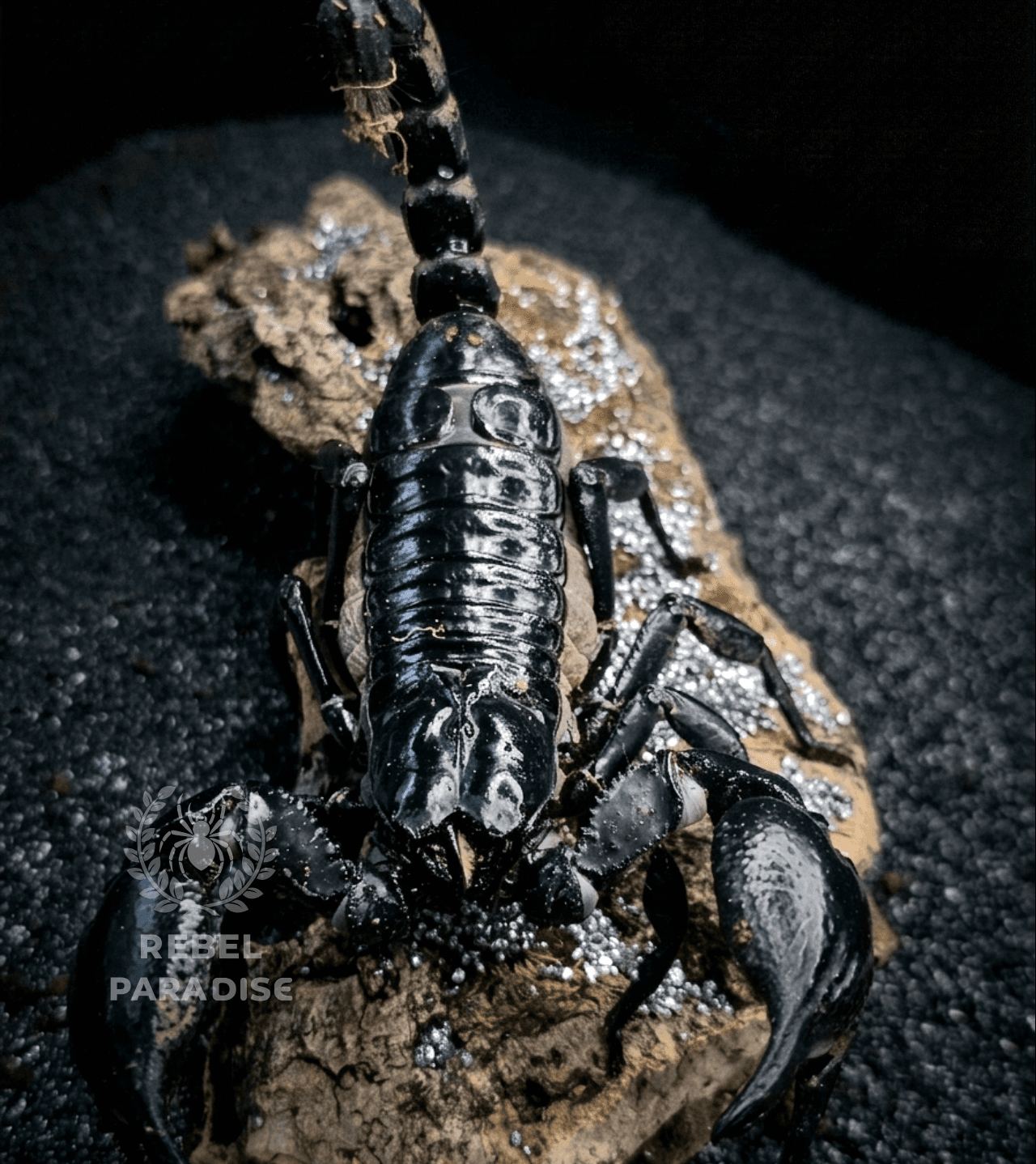
Heterometrus silenus is a large Asian forest scorpion of the family Scorpionidae. Described by Simon in 1884 from Cochinchina (today southern Vietnam), it occurs in Thailand, Cambodia and Vietnam. Adults reach about 10–12 cm, with a black body showing a greenish or bluish sheen and massive pincers. Like other Heterometrus it defends itself mainly with its pincers, and its venom is considered weak. It is nocturnal, burrows and needs moist substrate. A 2023 revision showed that some Thai populations previously treated as H. laoticus belong to H. silenus.
Care at a glance
Size
Adults about 10–12 cm body length
Enclosure type
Terrestrial, horizontal, with deep substrate
Substrate
10–15 cm, kept slightly moist lower down
Furnishings
Flat bark or stone as a hide, shallow water dish
Conditions
24–28°C, higher humidity, ventilation
Characteristics
Burrower, nocturnal, defends with pincers, weak venom
Current listings

Origin and distribution
Thailand, Cambodia and Vietnam
It occurs naturally in Thailand, Cambodia and Vietnam.
Appearance and size
Heterometrus silenus has a black exoskeleton with a greenish or bluish sheen, especially on the pincers. The pincers are broad and massive, and the tail (metasoma) is relatively short compared with the body. Like most scorpions it glows clearly under UV light.
Adults reach about 10–12 cm in length. Males and females look alike; males usually have slimmer pincers and longer pectines on the underside.
Origin and look-alike species
The species was described from Cochinchina, southern Vietnam. According to a 2023 revision it occurs in eastern Thailand as well as in Cambodia and Vietnam, and specimens have also been found west of Nakhon Pathom. Some Thai populations previously identified as H. laoticus were assigned to H. silenus.
The genus Heterometrus includes many similar species, and H. silenus, H. spinifer, H. laoticus and H. petersii are often confused in the trade. Ask about the origin of the line when buying.
Enclosure and substrate
A single adult scorpion needs an enclosure with a floor of about 40 × 30 cm. A deep substrate layer matters more than height: 10–15 cm of soil, coco fibre and peat, in which the scorpion digs a burrow. A flat piece of bark or a stone set firmly on the substrate gives it a starting point.
Heterometrus can climb silicone seams and rough walls, so the lid must be secure. Place heavy decor directly on the floor so the scorpion cannot be crushed while digging.
Temperature and humidity
The species comes from humid forest and needs 24–28°C and substrate that stays slightly moist lower down. Water along the edge every few days so moisture soaks into the lower layers.
A shallow water dish is recommended. Humidity must not mean stale air: wet substrate without ventilation encourages mould and mites.
Feeding, growth and breeding
The scorpion hunts at night. Adults do fine with 2–3 large crickets or roaches every one to two weeks; feed juveniles smaller prey more often. Remove uneaten insects so they do not disturb the scorpion during a moult.
Scorpions give birth to live young, which ride on the mother’s back for the first weeks. Do not disturb the female during this time. Heterometrus live several years and usually mature after 2–3 years.
Behaviour and safety
Heterometrus silenus is nervous: when disturbed it raises its pincers and tail and pinches if needed. A pinch from a large specimen is noticeable, and a sting is usually compared to a wasp sting, although allergic reactions are possible.
Use long tongs for maintenance and a container for rehousing. Do not handle the scorpion. Group keeping is practised, but it needs a large enclosure, many hides and generous feeding; keeping individuals singly is safer.
Good to know
Heterometrus silenus defends itself mainly with its pincers; its venom is considered weak, but a sting is painful, and allergic people may react more strongly. In case of systemic symptoms contact a doctor; this page is not medical advice. The species is not listed in the CITES appendices; obligations may depend on the country and the transaction, and this information is not legal advice.
Frequently asked questions
Is Heterometrus silenus dangerous?
Its venom is considered weak, and it defends itself mainly with its pincers. A sting is painful, often compared to a wasp sting; allergic people should be careful.
Is Heterometrus silenus suitable for beginners?
Yes, for keepers who accept a nervous scorpion and do not plan to handle it. Deep, moist substrate and a secure enclosure are what matter most.
How does it differ from Heterometrus spinifer and H. laoticus?
Heterometrus species are very similar and often confused in the trade. In 2023 some Thai populations identified as H. laoticus were assigned to H. silenus. Ask about the origin of the line when buying.
What enclosure does Heterometrus silenus need?
A horizontal one, about 40 × 30 cm for one adult, with 10–15 cm of moist substrate, a flat hide and a secure lid.
Where does Heterometrus silenus come from?
From Thailand, Cambodia and Vietnam. The species was described from southern Vietnam.
Similar species
Written by the Terra Market team ·